
This post was transferred from http://www.hebner.org
I’m not a big fan of Twitter or Facebook, principally because of the way most people use it. I have no interest in accessing a global communication platform to read about visits to Starbuck’s or Victoria’s Secret. Nor do I have any interest in responding to such missives. I do, however, fully recognize the importance this technology has socially, commercially, and even politically.
But, the size limit placed on Twitter posts has caused some consternation among professional writers and other lovers of the written word. I recently came across this comment online, posted by a fellow writer who felt straitjacketed by Twitter rules:
“Twitter and effective writing are mutually exclusive. Reducing one’s thoughts to 140 characters is the equivalent of turning “War and Peace” into haiku.”
I understand the writer’s frustration, but I don’t agree with the comments. You can do a lot with 140 characters, which is not to say that you can do anything and everything with just that many. Twitter is simply another medium. And like all mediums, a writing style will evolve to take advantage of it and make the best use of it. I also don’t see a single thing wrong with turning War and Peace into haiku. I’ll bet Leo Tolstoy would agree.
Ironically, the writing profession has been here before. And, this is where (and when) Abe Lincoln comes into the picture. By the mid-nineteenth century, the Morse telegraph was both a technical and commercial success. The electrical telegraph was a short message system using binary code, differing from today’s complex and sophisticated digital communication systems only in speed and scale. Telegraph companies charged by the word and by the mile, which resulted in the development of a fast and concise writing style that discouraged the use of pronouns and articles. Sound familiar?
For a comparison of nineteenth century telegrams to the texts and tweets of the 21st century, consider the first telegram know to be sent by Abraham Lincoln. On June 9, 1848, the man who would be our sixteenth president and lead the nation through a horrific Civil War was attending the Whig Party national convention in Philadelphia when he sent the following telegram to the editor of a newspaper in Springfield, Illinois:
General TAYLOR has received the nomination of the Convention for President of the U. States.
A. LINCOLN.
That message comprised just 17 words and 103 characters. It even reads like a tweet. Telegraph companies of the day would have charged about 25 cents for ten words or less and every 100 hundred miles of distance. That means Old Abe paid at least five dollars, which is equal to about $135 today. I can’t imagine paying that much for a month of high speed Internet access, let alone a single message. No wonder Lincoln didn’t mention where he’d had coffee that morning.
In fact, he was our first online president. Lincoln was a strong supporter of technological innovation and a fierce early adopter. His pioneering use of the telegraph as a tool of political and military leadership has been the subject of a number of research projects and a notable book, Mr. Lincoln’s T-Mails by Tom Wheeler. Wheeler draws a convincing comparison between Lincoln’s use of the telegraph and our modern use of email. However, I think Mr. Lincoln came much closer to what we know today as social media, rather than email. The difference is in the way Lincoln used the technology as a resource. According to Mr. Wheeler, Lincoln spent a great deal of his time at the War Department’s telegraph office, which the President used as his Situation Room. But, instead of just sending and receiving messages for himself, he would open a drawer containing copies of received messages and read them all, whether they were meant for his eyes or not. He could see what everyone using the war Department’s telegraph system was saying and thinking.
Lincoln used the telegraph system as an open forum, much the same as Twitter or Facebook. It was a completely one-sided forum, to be sure, but it was a forum nonetheless, and arguably, an open one (at least for Lincoln).
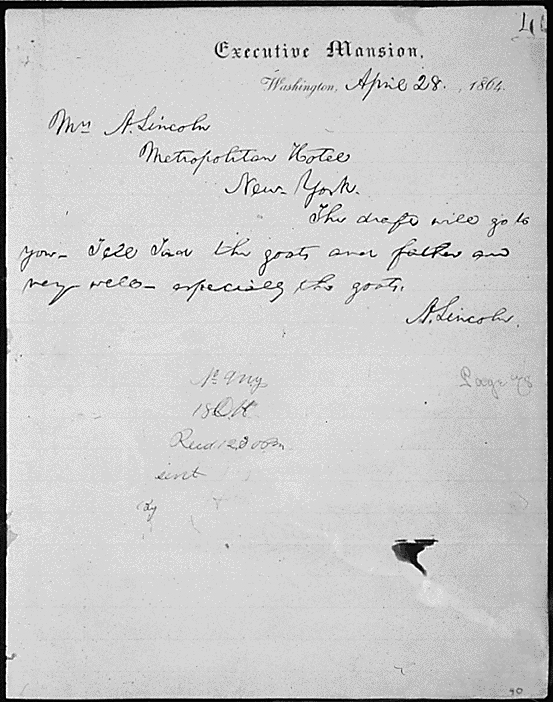
Abraham Lincoln's telegram to his wife, Mary Todd Lincoln, sent April 28, 1864. It reads, "The draft will go to you. Tell Tad the goats and father are well—especially the goats. A.Lincoln" (35 words, 196 characters) Source: National Archives
Despite the precedents set by Lincoln so long ago, I think we are only at the beginning of the evolution of an effective and aesthetically pleasing Twitter style. However, I have observed that online writing styles seem to evolve quickly, much faster than those that evolved for folio books, newspapers, mass-market magazines, and other periodicals. I’m sure we won’t need to wait long to see change.
So, I don’t think a 140-character-per-message limit will compromise our creativity or effectiveness. After all, people have been texting and tweeting for more than 160 years.
Paul H. Hebner
Originally posted on June 20, 2010
 Soapbox Junkie
This post is well written, educational, AND entertaining. I might link to it on my FB page. 🙂
Thanks for the compliments! I’d be flattered if you would link me to your FB page. I’ll also be sure to visit your blog.